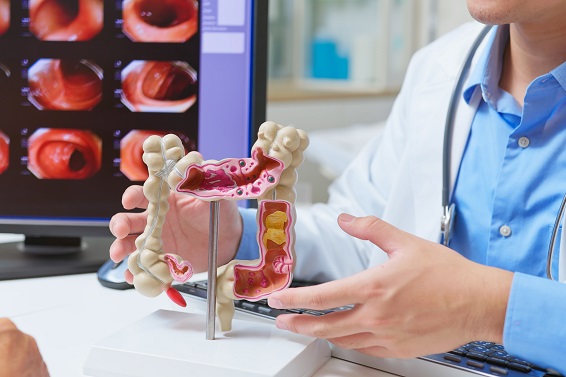
What is gastrointestinal endoscopy?
Gastrointestinal endoscopy generally includes gastroscopy and colonoscopy. Doctors use a soft, flexible endoscope fitted with a camera to examine the lining of the oesophagus, stomach, duodenum and large bowel. This helps diagnose digestive tract conditions such as gastritis, ulcers, polyps and tumours. If a suitable polyp is found during the examination, it may also be removed immediately and sent for laboratory testing.
Colonoscopy
A colonoscopy, also known as a colonoscopic examination, is performed through the anus to examine the rectum and the entire colon. It is an important tool for diagnosing colorectal conditions and for colorectal cancer screening.
As colorectal cancer often develops gradually from colorectal polyps, a colonoscopy allows doctors to detect polyps at an early stage and remove them during the procedure, thereby reducing the risk of these polyps developing into colorectal cancer.
A colonoscopy is commonly used in the following situations:
- To check for or monitor colorectal polyps
- To assess the cause of colorectal bleeding or a positive faecal occult blood test
- To investigate a sudden change in bowel habits, such as persistent diarrhoea or constipation
- To screen for or diagnose colorectal cancer
- To follow up chronic bowel inflammation or people at higher risk
Who may need a colonoscopy?
Your doctor may recommend a colonoscopy if you have any of the following:
- Persistent bowel symptoms, such as chronic diarrhoea, constipation, rectal bleeding or black stools
- A positive faecal occult blood test
- A family history of colorectal cancer, or being close to the recommended screening age (Hong Kong Government programme: aged 50 or above; in the United States, the starting age has been lowered to 45)
- Follow-up for colorectal polyps, chronic bowel inflammation or other higher-risk conditions
- Screening for early colorectal cancer and reducing the risk of death from bowel cancer
Gastroscopy
A gastroscopy, also known as an upper gastrointestinal endoscopy or oesophago-gastro-duodenoscopy (OGD), is performed through the mouth to examine the oesophagus, stomach and duodenum. It can help diagnose:
- Gastritis and gastric ulcers
- Acid reflux and oesophagitis
- Gastric polyps and stomach cancer
Gastroscopy allows doctors to observe changes inside the stomach directly, and, where necessary, to take tissue samples immediately for laboratory testing. This makes it more accurate than imaging tests for certain upper gastrointestinal conditions.
Who may need a gastroscopy?
Your doctor may recommend a gastroscopy if you have any of the following:
- Persistent stomach pain, frequent indigestion or gastro-oesophageal reflux
- Unexplained weight loss, difficulty swallowing, vomiting, black stools or blood in the stool
- A family history of stomach cancer or other digestive tract disease
- To rule out or further confirm serious conditions such as gastric tumours, ulcers, polyps or bleeding
- Particularly when there are worrying symptoms that require priority assessment
How should you prepare for gastrointestinal endoscopy?
Based on guidance from the HKU Endoscopy Centre, the following are the main preparation points for gastrointestinal endoscopy:
- Follow a low-residue / low-fibre diet for 3 days before the examination
For a colonoscopy, the lining of the rectum and colon needs to be clearly visible. You will therefore usually need to reduce high-fibre and hard-to-digest foods before the examination to prevent food residue from affecting the view. Suitable low-residue foods may include plain congee, white rice, white bread, fish and steamed egg.
- Avoid high-fibre foods or foods that leave residue
These include vegetables, fruit, brown rice, oats, nuts, sesame seeds, other seeds and pulses, which may leave residue in the bowel.
- ·Follow a fluid diet or other specified diet 1 day before the examination
Some centres will ask patients to switch to a fluid diet and take bowel-cleansing medication or strong laxatives at a specified time to help empty the bowel. Bowel preparation should be taken exactly as instructed by your doctor or endoscopy centre, without changing the dose yourself. Frequent bowel motions are expected during the cleansing process, so it is best to stay at home and keep up your fluid intake as advised.
- Avoid certain drinks 1 day before the examination
You should avoid milk, coloured drinks such as dark red or purple juices, which may be mistaken for bleeding during the examination, and fizzy drinks. Depending on the advice of your doctor or endoscopy centre, you may be allowed water, clear broth, strained apple juice, honey water or sports drinks to maintain hydration and reduce the risk of dehydration during bowel preparation.
- On the day of the examination: fast strictly
You will usually need to stop eating and drinking for at least 6 hours before the examination. The exact fasting period should follow the instructions given by your clinic or endoscopy centre, in order to reduce the risk of vomiting and aspiration pneumonia during anaesthesia or sedation.
- Tell your doctor in advance if you have a chronic condition or are taking regular medication
If you are taking blood thinners, diabetes medication, insulin, blood pressure medication or heart medication, you should inform your doctor in advance so that they can advise you on any necessary adjustments.
What happens during a gastrointestinal endoscopy?
- Registration and identity check (around 15 to 30 minutes)
When you arrive, medical staff will check your identity details and confirm again that you have completed the required bowel preparation for colonoscopy or fasting for gastroscopy.
- Anaesthesia or sedation (around 10 to 20 minutes)
A colonoscopy may be carried out under sedation to reduce discomfort. For a gastroscopy, a local anaesthetic is usually sprayed onto the throat first, and sedation or pain relief may also be used depending on the situation.
- The gastroscopy or colonoscopy itself (around 10 to 45 minutes)
Colonoscopy: The endoscope is inserted through the anus and advanced into the colon. The examination commonly takes around 30 to 45 minutes, depending on the findings. If polyps are found, they may be removed during the same procedure. Where necessary, the doctor may also take tissue samples for biopsy and histological examination.
Gastroscopy: The endoscope is passed through the mouth to examine the throat, oesophagus, stomach and duodenum. The examination usually takes about 10 minutes. If needed, the doctor can pass instruments through the scope to take tissue samples for pathological examination.
- Recovery and observation after the examination (around 30 minutes to 2 hours)
After the procedure, you will need to rest in the recovery area until the effects of the sedation or anaesthetic have worn off. Temporary bloating, throat discomfort, dizziness or drowsiness may occur. Once you are fully awake, the doctor will usually explain the initial findings. If tissue samples were taken or polyps were removed, you will need to wait for the pathology report and attend follow-up as advised.
- Discharge
If you have been given sedatives or anaesthetic medication, you should not drive, operate machinery or sign important documents on the same day. It is also advisable to have a family member or friend accompany you home. If you develop severe abdominal pain, fever, persistent vomiting or a large amount of blood in the stool, seek medical attention as soon as possible.
Is gastrointestinal endoscopy painful?
In general, gastrointestinal endoscopy is not usually described as painful, although it may cause short-lived discomfort. During a gastroscopy, the most common sensations are throat irritation or gagging. During a colonoscopy, some people may experience bloating or a pulling sensation. In most cases, these symptoms can be significantly reduced with local anaesthetic, sedation or pain relief. For most people, the discomfort is manageable and the examination does not take long.
Are there any risks associated with gastrointestinal endoscopy?
Colonoscopy and gastroscopy are routine medical procedures and the overall risk is low. Possible issues include:
- Temporary throat discomfort or bloating
- Temporary dizziness or drowsiness caused by sedative medication
- In rare cases, bleeding or perforation
Your doctor will assess the risks before the examination to help ensure the procedure is as safe as possible.
How much does gastrointestinal endoscopy cost in Hong Kong?
- Colonoscopy costs
This usually ranges from HK$5,000 to HK$20,000, depending on whether the procedure is carried out at a private clinic or day centre, or at a private hospital, as well as the type of anaesthesia used and the number of polyps removed.
- Gastroscopy costs
This usually ranges from HK$3,000 to HK$8,000, depending on the type of anaesthesia used, whether any polyps are removed, and whether the procedure is carried out in a clinic or a hospital.
How often should gastrointestinal endoscopy be done?
For people at average risk whose colonoscopy result is normal, another examination is usually only needed after about 10 years. If a high-risk adenomatous polyp has previously been found, repeat examination is generally recommended after 3 years. If only small, low-risk polyps were found, follow-up may be advised after 5 to 10 years.
Colorectal Cancer Screening Programme
If you are considering a colonoscopy, it is worth first checking whether you are eligible for government-subsidised screening, as you may be able to complete the examination and follow-up with a lower out-of-pocket cost.
Hong Kong’s Colorectal Cancer Screening Programme is implemented in phases and subsidises Hong Kong residents aged 50 to 75 who do not have symptoms of colorectal cancer to undergo a faecal immunochemical test every two years. If the result is positive, they will be referred to an enrolled colonoscopy specialist and can receive the government-subsidised standard colonoscopy service.
The government subsidy depends on whether polyp removal is required during the examination: HK$8,500 if polyp removal is needed, and HK$7,800 if no polyps are found or removed. When providing the standard colonoscopy service, the colonoscopy specialist may charge the participant an additional fee of no more than HK$1,000.
VHIS cover includes gastrointestinal endoscopy and polyp removal procedures
The Standard Plan and Flexi Plans under Hong Kong’s Voluntary Health Insurance Scheme generally cover medically necessary colonoscopy and gastroscopy recommended by a doctor, including day procedures. The scope of cover may include the examination itself, polyp removal and related consultation fees.
Prudential VHIS Series includes government-certified Standard Plans and Flexi Plans, offering protection options ranging from essential to more comprehensive cover for customers with different needs. The medical network covers a number of day procedure centres and imaging centres, enabling eligible customers to complete day procedures and diagnostic imaging examinations promptly^. The plans also offer a medical expense direct billing service**, under which Prudential can settle pre-approved medical expenses directly with network medical providers+, helping to ease concerns about upfront medical costs.
The series also provides a range of value-added services*, such as 24-hour worldwide emergency assistance, The Treatment Sure service1 (second medical opinion) and Medical Green Channel service2, helping customers receive more attentive support from diagnosis and treatment through to recovery.